General Sherman in Goldsboro and Raleigh
|
|||||||||||||||||||||||||||||||||||||||||||||||
|
This Site:
|
Quotes of General Sherman | General Sherman in the Civil War | Pictures of General William T. Sherman | General Sherman's Memoirs
MEMOIRS OF GENERAL W. T. SHERMANBy William T. ShermanEND OF THE WAR--FROM GOLDSBORO' TO RALEIGH AND WASHINGTONCONTENTS Volume II
CHAPTER XXIV.END OF THE WAR--FROM GOLDSBORO' TO RALEIGH AND WASHINGTON.APRIL AND MAY, 1865.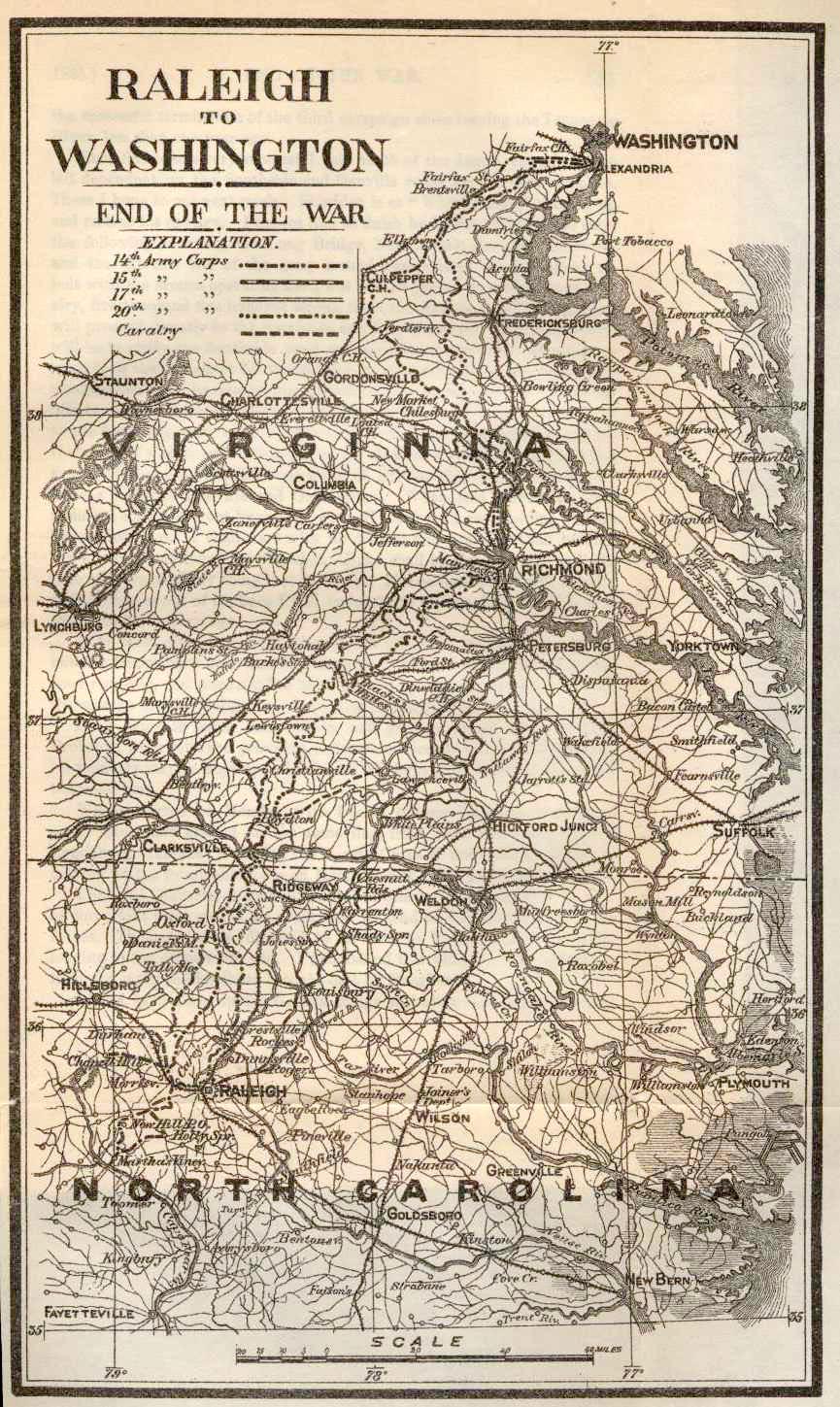
As before described, the armies commanded respectively by Generals J. M. Schofield, A. H. Terry, and myself, effected a junction in and about Goldsboro', North Carolina, during the 22d and 23d of March, 1865, but it required a few days for all the troops and trains of wagons to reach their respective camps. In person I reached Goldsboro' on the 23d, and met General Schofield, who described fully his operations in North Carolina up to that date; and I also found Lieutenant Dunn, aide-de-camp to General Grant, with a letter from him of March 16th, giving a general description of the state of facts about City Point. The next day I received another letter, more full, dated the 22d, which I give herewith. Nevertheless, I deemed it of great importance that I should have a personal interview with the general, and determined to go in person to City Point as soon as the repairs of the railroad, then in progress under the personal direction of Colonel W. W. Wright, would permit:
The railroad was repaired to Goldsboro' by the evening of March 25th, when, leaving General Schofield in chief command, with a couple of staff-officers I started for City Point, Virginia, in a locomotive, in company with Colonel Wright, the constructing engineer. We reached Newbern that evening, which was passed in the company of General Palmer and his accomplished lady, and early the next morning we continued on to Morehead City, where General Easton had provided for us the small captured steamer Russia, Captain Smith. We put to sea at once and steamed up the coast, reaching Fortress Monroe on the morning of the 27th, where I landed and telegraphed to my brother, Senator Sherman, at Washington, inviting him to come down and return with me to Goldsboro. We proceeded on up James River to City Point, which we reached the same afternoon. I found General Grant, with his family and staff, occupying a pretty group of huts on the bank of James River, overlooking the harbor, which was full of vessels of all classes, both war and merchant, with wharves and warehouses on an extensive scale. The general received me most heartily, and we talked over matters very fully. After I had been with him an hour or so, he remarked that the President, Mr. Lincoln, was then on board the steamer River Queen, lying at the wharf, and he proposed that we should call and see him. We walked down to the wharf, went on board, and found Mr. Lincoln alone, in the after-cabin. He remembered me perfectly, and at once engaged in a most interesting conversation. He was full of curiosity about the many incidents of our great march, which had reached him officially and through the newspapers, and seemed to enjoy very much the more ludicrous parts-about the "bummers," and their devices to collect food and forage when the outside world supposed us to be starving; but at the same time he expressed a good deal of anxiety lest some accident might happen to the army in North Carolina during my absence. I explained to him that that army was snug and comfortable, in good camps, at Goldsboro'; that it would require some days to collect forage and food for another march; and that General Schofield was fully competent to command it in my absence. Having made a good, long, social visit, we took our leave and returned to General Grant's quarters, where Mrs. Grant had provided tea. While at the table, Mrs. Grant inquired if we had seen Mrs. Lincoln. "No," said the general, "I did not ask for her;" and I added that I did not even know that she was on board. Mrs. Grant then exclaimed, "Well, you are a pretty pair!" and added that our neglect was unpardonable; when the general said we would call again the next day, and make amends for the unintended slight. Early the next day, March 28th, all the principal officers of the army and navy called to see me, Generals Meade, Ord, Ingalls, etc., and Admiral Porter. At this time the River Queen was at anchor out in the river, abreast of the wharf, and we again started to visit Mr. and Mrs. Lincoln. Admiral Porter accompanied us. We took a small, tug at the wharf, which conveyed us on board, where we were again received most courteously by the President, who conducted us to the after-cabin. After the general compliments, General Grant inquired after Mrs. Lincoln, when the President went to her stateroom, returned, and begged us to excuse her, as she was not well. We then again entered upon a general conversation, during which General Grant explained to the President that at that very instant of time General Sheridan was crossing James River from the north, by a pontoon-bridge below City Point; that he had a large, well-appointed force of cavalry, with which he proposed to strike the Southside and Danville Railroads, by which alone General Lee, in Richmond, supplied his army; and that, in his judgment, matters were drawing to a crisis, his only apprehension being that General Lee would not wait long enough. I also explained that my army at Goldsboro' was strong enough to fight Lee's army and Johnston's combined, provided that General Grant could come up within a day or so; that if Lee would only remain in Richmond another fortnight, I could march up to Burkesville, when Lee would have to starve inside of his lines, or come out from his intrenchments and fight us on equal terms. Both General Grant and myself supposed that one or the other of us would have to fight one more bloody battle, and that it would be the last. Mr. Lincoln exclaimed, more than once, that there had been blood enough shed, and asked us if another battle could not be avoided. I remember well to have said that we could not control that event; that this necessarily rested with our enemy; and I inferred that both Jeff. Davis and General Lee would be forced to fight one more desperate and bloody battle. I rather supposed it would fall on me, somewhere near Raleigh; and General Grant added that, if Lee would only wait a few more days, he would have his army so disposed that if the enemy should abandon Richmond, and attempt to make junction with General Jos. Johnston in North Carolina, he (General Grant) would be on his heels. Mr. Lincoln more than once expressed uneasiness that I was not with my army at Goldsboro', when I again assured him that General Schofield was fully competent to command in my absence; that I was going to start back that very day, and that Admiral Porter had kindly provided for me the steamer Bat, which he said was much swifter than my own vessel, the Russia. During this interview I inquired of the President if he was all ready for the end of the war. What was to be done with the rebel armies when defeated? And what should be done with the political leaders, such as Jeff. Davis, etc.? Should we allow them to escape, etc.? He said he was all ready; all he wanted of us was to defeat the opposing armies, and to get the men composing the Confederate armies back to their homes, at work on their farms and in their shops. As to Jeff. Davis, he was hardly at liberty to speak his mind fully, but intimated that he ought to clear out, "escape the country," only it would not do for him to say so openly. As usual, he illustrated his meaning by a story: A man once had taken the total-abstinence pledge. When visiting a friend, he was invited to take a drink, but declined, on the score of his pledge; when his friend suggested lemonade, which was accepted. In preparing the lemonade, the friend pointed to the brandy-bottle, and said the lemonade would be more palatable if he were to pour in a little brandy; when his guest said, if he could do so "unbeknown" to him, he would "not object." From which illustration I inferred that Mr. Lincoln wanted Davis to escape, "unbeknown" to him. I made no notes of this conversation at the time, but Admiral Porter, who was present, did, and in 1866 he furnished me an account thereof, which I insert below, but the admiral describes the first visit, of the 27th, whereas my memory puts Admiral Porter's presence on the following day. Still he may be right, and he may have been with us the day before, as I write this chiefly from memory. There were two distinct interviews; the first was late in the afternoon of March 27th, and the other about noon of the 28th, both in the after-cabin of the steamer River Queen; on both occasions Mr. Lincoln was full and frank in his conversation, assuring me that in his mind he was all ready for the civil reorganization of affairs at the South as soon as the war was over; and he distinctly authorized me to assure Governor Vance and the people of North Carolina that, as soon as the rebel armies laid down their arms, and resumed their civil pursuits, they would at once be guaranteed all their rights as citizens of a common country; and that to avoid anarchy the State governments then in existence, with their civil functionaries, would be recognized by him as the government de facto till Congress could provide others. I know, when I left him, that I was more than ever impressed by his kindly nature, his deep and earnest sympathy with the afflictions of the whole people, resulting from the war, and by the march of hostile armies through the South; and that his earnest desire seemed to be to end the war speedily, without more bloodshed or devastation, and to restore all the men of both sections to their homes. In the language of his second inaugural address, he seemed to have "charity for all, malice toward none," and, above all, an absolute faith in the courage, manliness, and integrity of the armies in the field. When at rest or listening, his legs and arms seemed to hang almost lifeless, and his face was care-worn and haggard; but, the moment he began to talk, his face lightened up, his tall form, as it were, unfolded, and he was the very impersonation of good-humor and fellowship. The last words I recall as addressed to me were that he would feel better when I was back at Goldsboro'. We parted at the gangway of the River Queen, about noon of March 28th, and I never saw him again. Of all the men I ever met, he seemed to possess more of the elements of greatness, combined with goodness, than any other.
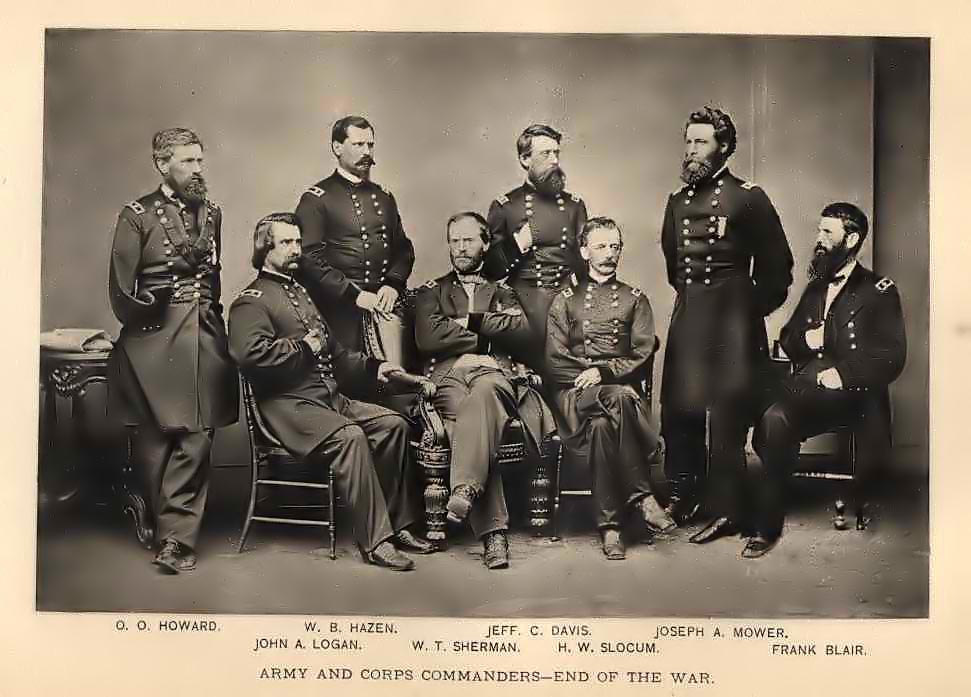
As soon as possible, I arranged with General Grant for certain changes in the organization of my army; and the general also undertook to send to North Carolina some tug-boat and barges to carry stores from Newbern up as far as Kinston, whence they could be hauled in wagons to our camps, thus relieving our railroads to that extent. I undertook to be ready to march north by April 10th, and then embarked on the steamer Bat, Captain Barnes, for North Carolina. We steamed down James River, and at Old Point Comfort took on board my brother, Senator Sherman, and Mr. Edwin Stanton, son of the Secretary of War, and proceeded at once to our destination. On our way down the river, Captain Barnes expressed himself extremely obliged to me for taking his vessel, as it had relieved him of a most painful dilemma. He explained that he had been detailed by Admiral Porter to escort the President's unarmed boat, the River Queen, in which capacity it became his special duty to look after Mrs. Lincoln. The day before my arrival at City Point, there had been a grand review of a part of the Army of the James, then commanded by General Ord. The President rode out from City Point with General Grant on horseback, accompanied by a numerous staff, including Captain Barnes and Mrs. Ord; but Mrs. Lincoln and Mrs. Grant had followed in a carriage. The cavalcade reached the review-ground some five or six miles out from City Point, found the troops all ready, drawn up in line, and after the usual presentation of arms, the President and party, followed by Mrs. Ord and Captain Barnes on horseback, rode the lines, and returned to the reviewing stand, which meantime had been reached by Mrs. Lincoln and Mrs. Grant in their carriage, which had been delayed by the driver taking a wrong road. Mrs. Lincoln, seeing Mrs. Ord and Captain Barnes riding with the retinue, and supposing that Mrs. Ord had personated her, turned on Captain Barnes and gave him a fearful scolding; and even indulged in some pretty sharp upbraidings to Mrs. Ord. This made Barne's position very unpleasant, so that he felt much relieved when he was sent with me to North Carolina. The Bat was very fast, and on the morning of the 29th we were near Cape Hatteras; Captain Barnes, noticing a propeller coming out of Hatteras Inlet, made her turn back and pilot us in. We entered safely, steamed up Pamlico Sound into Neuse River, and the next morning,--by reason of some derangement of machinery, we anchored about seven miles below Newbern, whence we went up in Captain Barnes's barge. As soon as we arrived at Newbern, I telegraphed up to General Schofield at Goldsboro' the fact of my return, and that I had arranged with General Grant for the changes made necessary in the reorganization of the army, and for the boats necessary to carry up the provisions and stores we needed, prior to the renewal of our march northward. These changes amounted to constituting the left wing a distinct army, under the title of "the Army of Georgia," under command of General Slocum, with his two corps commanded by General Jeff. C. Davis and General Joseph A. Mower; the Tenth and Twenty-third Corps already constituted another army, "of the Ohio," under the command of Major-General Schofield, and his two corps were commanded by Generals J. D. Cox and A. H. Terry. These changes were necessary, because army commanders only could order courts-martial, grant discharges, and perform many other matters of discipline and administration which were indispensable; but my chief purpose was to prepare the whole army for what seemed among the probabilities of the time--to fight both Lee's and Johnston's armies combined, in case their junction could be formed before General Grant could possibly follow Lee to North Carolina. General George H. Thomas, who still remained at Nashville, was not pleased with these changes, for the two corps with General Slocum, viz., the Fourteenth and Twentieth, up to that time, had remained technically a part of his "Army of the Cumberland;" but he was so far away, that I had to act to the best advantage with the troops and general officers actually present. I had specially asked for General Mower to command the Twentieth Corps, because I regarded him as one of the boldest and best fighting generals in the whole army. His predecessor, General A. S. Williams, the senior division commander present, had commanded the corps well from Atlanta to Goldsboro', and it may have seemed unjust to replace him at that precise moment; but I was resolved to be prepared for a most desperate and, as then expected, a final battle, should it fall on me. I returned to Goldsboro' from Newbern by rail the evening of March 30th, and at once addressed myself to the task of reorganization and replenishment of stores, so as to be ready to march by April 10th, the day agreed on with General Grant. The army was divided into the usual three parts, right and left wings, and centre. The tabular statements herewith will give the exact composition of these separate armies, which by the 10th of April gave the following effective strength:
The railroads to our rear had also been repaired, so that stores were arriving very fast, both from Morehead City and Wilmington. The country was so level that a single locomotive could haul twenty-five and thirty cars to a train, instead of only ten, as was the case in Tennessee and Upper Georgia. By the 5th of April such progress had been made, that I issued the following Special Field Orders, No. 48, prescribing the time and manner of the next march
But the whole problem became suddenly changed by the news of the fall of Richmond and Petersburg, which reached as at Goldsboro', on the 6th of April. The Confederate Government, with Lee's army, had hastily abandoned Richmond, fled in great disorder toward Danville, and General Grant's whole army was in close pursuit. Of course, I inferred that General Lee would succeed in making junction with General Johnston, with at least a fraction of his army, somewhere to my front. I at once altered the foregoing orders, and prepared on the day appointed, viz., April 10th, to move straight on Raleigh, against the army of General Johnston, known to be at Smithfield, and supposed to have about thirty-five thousand men. Wade Hampton's cavalry was on his left front and Wheeler's on his right front, simply watching us and awaiting our initiative. Meantime the details of the great victories in Virginia came thick and fast, and on the 8th I received from General Grant this communication, in the form of a cipher-dispatch:
I answered immediately that we would move on the 10th, prepared to follow Johnston wherever he might go. Promptly on Monday morning, April 10th, the army moved straight on Smithfield; the right wing making a circuit by the right, and the left wing, supported by the centre, moving on the two direct roads toward Raleigh, distant fifty miles. General Terry's and General Kilpatrick's troops moved from their positions on the south or west bank of the Neuse River in the same general direction, by Cox's Bridge. On the 11th we reached Smithfield, and found it abandoned by Johnston's army, which had retreated hastily on Raleigh, burning the bridges. To restore these consumed the remainder of the day, and during that night I received a message from General Grant, at Appomattox, that General Lee had surrendered to him his whole army, which I at once announced to the troops in orders:
Of course, this created a perfect furore, of rejoicing, and we all regarded the war as over, for I knew well that General Johnston had no army with which to oppose mine. So that the only questions that remained were, would he surrender at Raleigh? or would he allow his army to disperse into guerrilla bands, to "die in the last ditch," and entail on his country an indefinite and prolonged military occupation, and of consequent desolation? I knew well that Johnston's army could not be caught; the country was too open; and, without wagons, the men could escape us, disperse, and assemble again at some place agreed on, and thus the war might be prolonged indefinitely. I then remembered Mr. Lincoln's repeated expression that he wanted the rebel soldiers not only defeated, but "back at their homes, engaged in their civil pursuits." On the evening of the 12th I was with the head of Slocum's column, at Gulley's, and General Kilpatrick's cavalry was still ahead, fighting Wade Hampton's rear-guard, with orders to push it through Raleigh, while I would give a more southerly course to the infantry columns, so as, if possible, to prevent a retreat southward. On the 13th, early, I entered Raleigh, and ordered the several heads of column toward Ashville in the direction of Salisbury or Charlotte. Before reaching Raleigh, a locomotive came down the road to meet me, passing through both Wade Hampton's and Kilpatrick's cavalry, bringing four gentlemen, with a letter from Governor Vance to me, asking protection for the citizens of Raleigh. These gentlemen were, of course, dreadfully excited at the dangers through which they had passed. Among them were ex-Senator Graham, Mr. Swain, president of Chapel Hill University, and a Surgeon Warren, of the Confederate army. They had come with a flag of truce, to which they were not entitled; still, in the interest of peace, I respected it, and permitted them to return to Raleigh with their locomotive, to assure the Governor and the people that the war was substantially over, and that I wanted the civil authorities to remain in the execution of their office till the pleasure of the President could be ascertained. On reaching Raleigh I found these same gentlemen, with Messrs. Badger, Bragg, Holden, and others, but Governor Vance had fled, and could not be prevailed on to return, because he feared an arrest and imprisonment. From the Raleigh newspapers of the 10th I learned that General Stoneman, with his division of cavalry, had come across the mountains from East Tennessee, had destroyed the railroad at Salisbury, and was then supposed to be approaching Greensboro'. I also learned that General Wilson's cavalry corps was "smashing things" down about Selma and Montgomery, Alabama, and was pushing for Columbus and Macon, Georgia; and I also had reason to expect that General Sheridan would come down from Appomattox to join us at Raleigh with his superb cavalry corps. I needed more cavalry to check Johnston's retreat, so that I could come up to him with my infantry, and therefore had good reason to delay. I ordered the railroad to be finished up to Raleigh, so that I could operate from it as a base, and then made:
Thus matters stood, when on the morning of the 14th General Kilpatrick reported from Durham's Station, twenty-six miles up the railroad toward Hillsboro', that a flag of truce had come in from the enemy with a package from General Johnston addressed to me. Taking it for granted that this was preliminary to a surrender, I ordered the message to be sent me at Raleigh, and on the 14th received from General Johnston a letter dated April 13, 1865, in these words:
To which I replied as follows:
I sent my aide-de-camp, Colonel McCoy, up to Durham's Station with this letter, with instructions to receive the answer, to telegraph its contents back to me at Raleigh, and to arrange for an interview. On the 16th I received a reply from General Johnston, agreeing to meet me the next day at a point midway between our advance at Durham and his rear at Hillsboro'. I ordered a car and locomotive to be prepared to convey me up to Durham's at eight o'clock of the morning of April 17th. Just as we were entering the car, the telegraph-operator, whose office was up-stairs in the depot-building, ran down to me and said that he was at that instant of time receiving a most important dispatch in cipher from Morehead City, which I ought to see. I held the train for nearly half an hour, when he returned with the message translated and written out. It was from Mr. Stanton, announcing the assassination of Mr. Lincoln, the attempt on the life of Mr. Seward and son, and a suspicion that a like fate was designed for General Grant and all the principal officers of the Government. Dreading the effect of such a message at that critical instant of time, I asked the operator if any one besides himself had seen it; he answered No! I then bade him not to reveal the contents by word or look till I came back, which I proposed to do the same afternoon. The train then started, and, as we passed Morris's Station, General Logan, commanding the Fifteenth Corps, came into my car, and I told him I wanted to see him on my return, as I had something very important to communicate. He knew I was going to meet General Johnston, and volunteered to say that he hoped I would succeed in obtaining his surrender, as the whole army dreaded the long march to Charlotte (one hundred and seventy-five miles), already begun, but which had been interrupted by the receipt of General Johnston's letter of the 13th. We reached Durham's, twenty-six miles, about 10 a.m., where General Kilpatrick had a squadron of cavalry drawn up to receive me. We passed into the house in which he had his headquarters, and soon after mounted some led horses, which he had prepared for myself and staff. General Kilpatrick sent a man ahead with a white flag, followed by a small platoon, behind which we rode, and were followed by the rest of the escort. We rode up the Hillsboro' road for about five miles, when our flag bearer discovered another coming to meet him: They met, and word was passed back to us that General Johnston was near at hand, when we rode forward and met General Johnston on horseback, riding side by side with General Wade Hampton. We shook hands, and introduced our respective attendants. I asked if there was a place convenient where we could be private, and General Johnston said he had passed a small farmhouse a short distance back, when we rode back to it together side by side, our staff-officers and escorts following. We had never met before, though we had been in the regular army together for thirteen years; but it so happened that we had never before come together. He was some twelve or more years my senior; but we knew enough of each other to be well acquainted at once. We soon reached the house of a Mr. Bennett, dismounted, and left our horses with orderlies in the road. Our officers, on foot, passed into the yard, and General Johnston and I entered the small frame-house. We asked the farmer if we could have the use of his house for a few minutes, and he and his wife withdrew into a smaller log-house, which stood close by. As soon as we were alone together I showed him the dispatch announcing Mr. Lincoln's assassination, and watched him closely. The perspiration came out in large drops on his forehead, and he did not attempt to conceal his distress. He denounced the act as a disgrace to the age, and hoped I did not charge it to the Confederate Government. I told him I could not believe that he or General Lee, or the officers of the Confederate army, could possibly be privy to acts of assassination; but I would not say as much for Jeff. Davis, George Sanders, and men of that stripe. We talked about the effect of this act on the country at large and on the armies, and he realized that it made my situation extremely delicate. I explained to him that I had not yet revealed the news to my own personal staff or to the army, and that I dreaded the effect when made known in Raleigh. Mr. Lincoln was peculiarly endeared to the soldiers, and I feared that some foolish woman or man in Raleigh might say something or do something that would madden our men, and that a fate worse than that of Columbia would befall the place. I then told Johnston that he must be convinced that he could not oppose my army, and that, since Lee had surrendered, he could do the same with honor and propriety. He plainly and repeatedly admitted this, and added that any further fighting would be "murder;" but he thought that, instead of surrendering piecemeal, we might arrange terms that would embrace all the Confederate armies. I asked him if he could control other armies than his own; he said, not then, but intimated that he could procure authority from Mr. Davis. I then told him that I had recently had an interview with General Grant and President Lincoln, and that I was possessed of their views; that with them and the people North there seemed to be no vindictive feeling against the Confederate armies, but there was against Davis and his political adherents; and that the terms that General Grant had given to General Lee's army were certainly most generous and liberal. All this he admitted, but always recurred to the idea of a universal surrender, embracing his own army, that of Dick Taylor in Louisiana and Texas, and of Maury, Forrest, and others, in Alabama and Georgia. General Johnston's account of our interview in his "Narrative" (page 402, et seq.) is quite accurate and correct, only I do not recall his naming the capitulation of Loeben, to which he refers. Our conversation was very general and extremely cordial, satisfying me that it could have but one result, and that which we all desired, viz., to end the war as quickly as possible; and, being anxious to return to Raleigh before the news of Mr. Lincoln's assassination could be divulged, on General Johnston's saying that he thought that, during the night, he could procure authority to act in the name of all the Confederate armies in existence we agreed to meet again the next day at noon at the same place, and parted, he for Hillsboro' and I for Raleigh. We rode back to Durham's Station in the order we had come, and then I showed the dispatch announcing Mr. Lincoln's death. I cautioned the officers to watch the soldiers closely, to prevent any violent retaliation by them, leaving that to the Government at Washington; and on our way back to Raleigh in the cars I showed the same dispatch to General Logan and to several of the officers of the Fifteenth Corps that were posted at Morrisville and Jones's Station, all of whom were deeply impressed by it; but all gave their opinion that this sad news should not change our general course of action. As soon as I reached Raleigh I published the following orders to the army, announcing the assassination of the President, and I doubt if, in the whole land, there were more sincere mourners over his sad fate than were then in and about Raleigh. I watched the effect closely, and was gratified that there was no single act of retaliation; though I saw and felt that one single word by me would have laid the city in ashes, and turned its whole population houseless upon the country, if not worse:
During the evening of the 17th and morning of the 18th I saw nearly all the general officers of the army (Schofield, Slocum, Howard, Logan, Blair), and we talked over the matter of the conference at Bennett's house of the day before, and, without exception, all advised me to agree to some terms, for they all dreaded the long and harassing march in pursuit of a dissolving and fleeing army--a march that might carry us back again over the thousand miles that we had just accomplished. We all knew that if we could bring Johnston's army to bay, we could destroy it in an hour, but that was simply impossible in the country in which we found ourselves. We discussed all the probabilities, among which was, whether, if Johnston made a point of it, I should assent to the escape from the country of Jeff. Davis and his fugitive cabinet; and some one of my general officers, either Logan or Blair, insisted that, if asked for, we should even provide a vessel to carry them to Nassau from Charleston. The next morning I again started in the cars to Durham's Station, accompanied by most of my personal staff, and by Generals Blair, Barry, Howard, etc., and, reaching General Kilpatrick's headquarters at Durham's, we again mounted, and rode, with the same escort of the day, before, to Bennett's house, reaching there punctually at noon. General Johnston had not yet arrived, but a courier shortly came, and reported him as on the way. It must have been nearly 2 p.m. when he arrived, as before, with General Wade Hampton. He had halted his escort out of sight, and we again entered Bennett's house, and I closed the door. General Johnston then assured me that he had authority over all the Confederate armies, so that they would obey his orders to surrender on the same terms with his own, but he argued that, to obtain so cheaply this desirable result, I ought to give his men and officers some assurance of their political rights after their surrender. I explained to him that Mr. Lincoln's proclamation of amnesty, of December 8, 1863, still in force; enabled every Confederate soldier and officer, below the rank of colonel, to obtain an absolute pardon, by simply laying down his arms, and taking the common oath of allegiance, and that General Grant, in accepting the surrender of General Lee's army, had extended the same principle to all the officers, General Lee included; such a pardon, I understood, would restore to them all their rights of citizenship. But he insisted that the officers and men of the Confederate army were unnecessarily alarmed about this matter, as a sort of bugbear. He then said that Mr. Breckenridge was near at hand, and he thought that it would be well for him to be present. I objected, on the score that he was then in Davis's cabinet, and our negotiations should be confined strictly to belligerents. He then said Breckenridge was a major-general in the Confederate army, and might sink his character of Secretary of War. I consented, and he sent one of his staff-officers back, who soon returned with Breckenridge, and he entered the room. General Johnston and I then again went over the whole ground, and Breckenridge confirmed what he had said as to the uneasiness of the Southern officers and soldiers about their political rights in case of surrender. While we were in consultation, a messenger came with a parcel of papers, which General Johnston said were from Mr. Reagan, Postmaster-General. He and Breckenridge looked over them, and, after some side conversation, he handed one of the papers to me. It was in Reagan's handwriting, and began with a long preamble and terms, so general and verbose, that I said they were inadmissible. Then recalling the conversation of Mr. Lincoln, at City Point, I sat down at the table, and wrote off the terms, which I thought concisely expressed his views and wishes, and explained that I was willing to submit these terms to the new President, Mr. Johnson, provided that both armies should remain in statu quo until the truce therein declared should expire. I had full faith that General Johnston would religiously respect the truce, which he did; and that I would be the gainer, for in the few days it would take to send the papers to Washington, and receive an answer, I could finish the railroad up to Raleigh, and be the better prepared for a long chase. Neither Mr. Breckenridge nor General Johnston wrote one word of that paper. I wrote it myself, and announced it as the best I could do, and they readily assented. While copies of this paper were being made for signature, the officers of our staffs commingled in the yard at Bennett's house, and were all presented to Generals Johnston and Breckenridge. All without exception were rejoiced that the war was over, and that in a very few days we could turn our faces toward home. I remember telling Breckenridge that he had better get away, as the feeling of our people was utterly hostile to the political element of the South, and to him especially, because he was the Vice-President of the United States, who had as such announced Mr. Lincoln, of Illinois, duly and properly elected the President of the United States, and yet that he had afterward openly rebelled and taken up arms against the Government. He answered me that he surely would give us no more trouble, and intimated that he would speedily leave the country forever. I may have also advised him that Mr. Davis too should get abroad as soon as possible. The papers were duly signed; we parted about dark, and my party returned to Raleigh. Early the next morning, April 19th, I dispatched by telegraph to Morehead City to prepare a fleet-steamer to carry a messenger to Washington, and sent Major Henry Hitchcock down by rail, bearing the following letters, and agreement with General Johnston, with instructions to be very careful to let nothing escape him to the greedy newspaper correspondents, but to submit his papers to General Halleck, General Grant, or the Secretary of War, and to bring me back with all expedition their orders and instructions. On their face they recited that I had no authority to make final terms involving civil or political questions, but that I submitted them to the proper quarter in Washington for their action; and the letters fully explained that the military situation was such that the delay was an advantage to us. I cared little whether they were approved, modified, or disapproved in toto; only I wanted instructions. Many of my general officers, among whom, I am almost positive, were Generals Logan and Blair, urged me to accept the "terms," without reference at all to Washington, but I preferred the latter course:
Major Hitchcock got off on the morning of the 20th, and I reckoned that it would take him four or five days to go to Washington and back. During that time the repairs on all the railroads and telegraph-lines were pushed with energy, and we also got possession of the railroad and telegraph from Raleigh to Weldon, in the direction of Norfolk. Meantime the troops remained statu quo, our cavalry occupying Durham's Station and Chapel Hill. General Slocum's head of column was at Aven's Ferry on Cape Fear River, and General Howard's was strung along the railroad toward Hillsboro'; the rest of the army was in and about Raleigh. On the 20th I reviewed the Tenth Corps, and was much pleased at the appearance of General Paines's division of black troops, the first I had ever seen as a part of an organized army; and on the 21st I reviewed the Twenty-third Corps, which had been with me to Atlanta, but had returned to Nashville had formed an essential part of the army which fought at Franklin, and with which General Thomas had defeated General Hood in Tennessee. It had then been transferred rapidly by rail to Baltimore and Washington by General Grant's orders, and thence by sea to North Carolina. Nothing of interest happened at Raleigh till the evening of April 23d, when Major Hitchcock reported by telegraph his return to Morehead City, and that he would come up by rail during the night. He arrived at 6 a.m., April 24th, accompanied by General Grant and one or two officers of his staff, who had not telegraphed the fact of their being on the train, for prudential reasons. Of course, I was both surprised and pleased to see the general, soon learned that my terms with Johnston had been disapproved, was instructed by him to give the forty-eight hours' notice required by the terms of the truce, and afterward to proceed to attack or follow him. I immediately telegraphed to General Kilpatrick, at Durham's, to have a mounted courier ready to carry the following message, then on its way up by rail, to the rebel lines:
At the same time I wrote another short note to General Johnston, of the same date:
Of course, both these papers were shown to General Grant at the time, before they were sent, and he approved of them. At the same time orders were sent to all parts of the army to be ready to resume the pursuit of the enemy on the expiration of the forty-eight hours' truce, and messages were sent to General Gillmore (at Hilton Head) to the same effect, with instructions to get a similar message through to General Wilson, at Macon, by some means. General Grant had brought with him, from Washington, written answers from the Secretary of War, and of himself, to my communications of the 18th, which I still possess, and here give the originals. They embrace the copy of a dispatch made by Mr. Stanton to General Grant, when he was pressing Lee at Appomattox, which dispatch, if sent me at the same time (as should have been done), would have saved a world of trouble. I did not understand that General Grant had come down to supersede me in command, nor did he intimate it, nor did I receive these communications as a serious reproof, but promptly acted on them, as is already shown; and in this connection I give my answer made to General Grant, at Raleigh, before I had received any answer from General Johnston to the demand for the surrender of his own army, as well as my answer to Mr. Stanton's letter, of the same date, both written on the supposition that I might have to start suddenly in pursuit of Johnston, and have no other chance to explain.
The following telegram was received 2 p.m., City Point, March 4, 1865 (from Washington, 12 M., March 3, 1865)
On the same day, but later, I received an answer from General Johnston, agreeing to meet me again at Bennett's house the next day, April 26th, at noon. He did not even know that General Grant was in Raleigh. General Grant advised me to meet him, and to accept his surrender on the same terms as his with General Lee; and on the 26th I again went up to Durham's Station by rail, and rode out to Bennett's house, where we again met, and General Johnston, without hesitation, agreed to, and we executed, the following final terms:
I returned to Raleigh the same evening, and, at my request, General Grant wrote on these terms his approval, and then I thought the matter was surely at an end. He took the original copy, on the 27th returned to Newbern, and thence went back to Washington. I immediately made all the orders necessary to carry into effect the terms of this convention, devolving on General Schofield the details of granting the parole and making the muster-rolls of prisoners, inventories of property, etc., of General Johnston's army at and about Greensboro', North Carolina, and on General Wilson the same duties in Georgia; but, thus far, I had been compelled to communicate with the latter through rebel sources, and General Wilson was necessarily confused by the conflict of orders and information. I deemed it of the utmost importance to establish for him a more reliable base of information and supply, and accordingly resolved to go in person to Savannah for that purpose. But, before starting, I received a New York Times, of April 24th, containing the following extraordinary communications:
Here followed the terms, and Mr. Stanton's ten reasons for rejecting them. The publication of this bulletin by authority was an outrage on me, for Mr. Stanton had failed to communicate to me in advance, as was his duty, the purpose of the Administration to limit our negotiations to purely military matters; but, on the contrary, at Savannah he had authorized me to control all matters, civil and military. By this bulletin, he implied that I had previously been furnished with a copy of his dispatch of March 3d to General Grant, which was not so; and he gave warrant to the impression, which was sown broadcast, that I might be bribed by banker's gold to permit Davis to escape. Under the influence of this, I wrote General Grant the following letter of April 28th, which has been published in the Proceedings of the Committee on the Conduct of the War. I regarded this bulletin of Mr. Stanton as a personal and official insult, which I afterward publicly resented.
On the 28th I summoned all the army and corps commanders together at my quarters in the Governor's mansion at Raleigh, where every thing was explained to them, and all orders for the future were completed. Generals Schofield, Terry, and Kilpatrick, were to remain on duty in the Department of North Carolina, already commanded by General Schofield, and the right and left wings were ordered to march under their respective commanding generals North by easy stages to Richmond, Virginia, there to await my return from the South. On the 29th of April, with a part of my personal staff, I proceeded by rail to Wilmington, North Carolina, where I found Generals Hawley and Potter, and the little steamer Russia, Captain Smith, awaiting me. After a short pause in Wilmington, we embarked, and proceeded down the coast to Port Royal and the Savannah River, which we reached on the 1st of May. There Captain Hoses, who had just come from General Wilson at Macon, met us, bearing letters for me and General Grant, in which General Wilson gave a brief summary of his operations up to date. He had marched from Eastport, Mississippi, five hundred miles in thirty days, took six thousand three hundred prisoners, twenty-three colors, and one hundred and fifty-six guns, defeating Forrest, scattering the militia, and destroying every railroad, iron establishment, and factory, in North Alabama and Georgia. He spoke in the highest terms of his cavalry, as "cavalry," claiming that it could not be excelled, and he regarded his corps as a model for modern cavalry in organization, armament, and discipline. Its strength was given at thirteen thousand five hundred men and horses on reaching Macon. Of course I was extremely gratified at his just confidence, and saw that all he wanted for efficient action was a sure base of supply, so that he need no longer depend for clothing, ammunition, food, and forage, on the country, which, now that war had ceased, it was our solemn duty to protect, instead of plunder. I accordingly ordered the captured steamer Jeff. Davis to be loaded with stores, to proceed at once up the Savannah River to Augusta, with a small detachment of troops to occupy the arsenal, and to open communication with General Wilson at Macon; and on the next day, May 2d, this steamer was followed by another with a fall cargo of clothing, sugar, coffee, and bread, sent from Hilton Head by the department commander, General Gillmore, with a stronger guard commanded by General Molineux. Leaving to General Gillmore, who was present, and in whose department General Wilson was, to keep up the supplies at Augusta, and to facilitate as far as possible General Wilson's operations inland, I began my return on the 2d of May. We went into Charleston Harbor, passing the ruins of old Forts Moultrie and Sumter without landing. We reached the city of Charleston, which was held by part of the division of General John P. Hatch, the same that we had left at Pocotaligo. We walked the old familiar streets--Broad, King, Meeting, etc.--but desolation and ruin were everywhere. The heart of the city had been burned during the bombardment, and the rebel garrison at the time of its final evacuation had fired the railroad-depots, which fire had spread, and was only subdued by our troops after they had reached the city. I inquired for many of my old friends, but they were dead or gone, and of them all I only saw a part of the family of Mrs. Pettigru. I doubt whether any city was ever more terribly punished than Charleston, but, as her people had for years been agitating for war and discord, and had finally inaugurated the civil war by an attack on the small and devoted garrison of Major Anderson, sent there by the General Government to defend them, the judgment of the world will be, that Charleston deserved the fate that befell her. Resuming our voyage, we passed into Cape Fear River by its mouth at Fort Caswell and Smithville, and out by the new channel at Fort Fisher, and reached Morehead City on the 4th of May. We found there the revenue-cutter Wayanda, on board of which were the Chief-Justice, Mr. Chase, and his daughter Nettie, now Mrs. Hoyt. The Chief-Justice at that moment was absent on a visit to Newbern, but came back the next day. Meantime, by means of the telegraph, I was again in correspondence with General Schofield at Raleigh. He had made great progress in paroling the officers and men of Johnston's army at Greensboro', but was embarrassed by the utter confusion and anarchy that had resulted from a want of understanding on many minor points, and on the political questions that had to be met at the instant. In order to facilitate the return to their homes of the Confederate officers and men, he had been forced to make with General Johnston the following supplemental terms, which were of course ratified and approved:
On the morning of the 5th I also received from General Schofield this dispatch:
I was utterly without instructions from any source on the points of General Schofield's inquiry, and under the existing state of facts could not even advise him, for by this time I was in possession of the second bulletin of Mr. Stanton, published in all the Northern papers, with comments that assumed that I was a common traitor and a public enemy; and high officials had even instructed my own subordinates to disobey my lawful orders. General Halleck, who had so long been in Washington as the chief of staff, had been sent on the 21st of April to Richmond, to command the armies of the Potomac and James, in place of General Grant, who had transferred his headquarters to the national capital, and he (General Halleck) was therefore in supreme command in Virginia, while my command over North Carolina had never been revoked or modified.
Subsequently, before the Committee on the Conduct of the War, in Washington, on the 22d of May, I testified fully on this whole matter, and will abide the judgment of the country on the patriotism and wisdom of my public conduct in this connection. General Halleck's measures to capture General Johnston's army, actually surrendered to me at the time, at Greensboro', on the 26th of April, simply excited my contempt for a judgment such as he was supposed to possess. The assertion that Jeff. Davis's specie-train, of six to thirteen million dollars, was reported to be moving south from Goldsboro' in wagons as fast as possible, found plenty of willing ears, though my army of eighty thousand men had been at Goldsboro' from March 22d to the date of his dispatch, April 26th; and such a train would have been composed of from fifteen to thirty-two six-mule teams to have hauled this specie, even if it all were in gold. I suppose the exact amount of treasure which Davis had with him is now known to a cent; some of it was paid to his escort, when it disbanded at and near Washington, Georgia, and at the time of his capture he had a small parcel of gold and silver coin, not to exceed ten thousand dollars, which is now retained in the United States Treasury-vault at Washington, and shown to the curious. The thirteen millions of treasure, with which Jeff. Davis was to corrupt our armies and buy his escape, dwindled down to the contents of a hand-valise! To say that I was merely angry at the tone and substance of these published bulletins of the War Department, would hardly express the state of my feelings. I was outraged beyond measure, and was resolved to resent the insult, cost what it might. I went to the Wayanda and showed them to Mr. Chase, with whom I had a long and frank conversation, during which he explained to me the confusion caused in Washington by the assassination of Mr. Lincoln, the sudden accession to power of Mr. Johnson, who was then supposed to be bitter and vindictive in his feelings toward the South, and the wild pressure of every class of politicians to enforce on the new President their pet schemes. He showed me a letter of his own, which was in print, dated Baltimore, April 11th, and another of April 12th, addressed to the President, urging him to recognize the freedmen as equal in all respects to the whites. He was the first man, of any authority or station, who ever informed me that the Government of the United States would insist on extending to the former slaves of the South the elective franchise, and he gave as a reason the fact that the slaves, grateful for their freedom, for which they were indebted to the armies and Government of the North, would, by their votes, offset the disaffected and rebel element of the white population of the South. At that time quite a storm was prevailing at sea, outside, and our two vessels lay snug at the wharf at Morehead City. I saw a good deal of Mr. Chase, and several notes passed between us, of which I have the originals yet. Always claiming that the South had herself freed all her slaves by rebellion, and that Mr. Lincoln's proclamation of freedom (of September 22, 1862) was binding on all officers of the General Government, I doubted the wisdom of at once clothing them with the elective franchise, without some previous preparation and qualification; and then realized the national loss in the death at that critical moment of Mr. Lincoln, who had long pondered over the difficult questions involved, who, at all events, would have been honest and frank, and would not have withheld from his army commanders at least a hint that would have been to them a guide. It was plain to me, therefore, that the manner of his assassination had stampeded the civil authorities in Washington, had unnerved them, and that they were then undecided as to the measures indispensably necessary to prevent anarchy at the South. On the 7th of May the storm subsided, and we put to sea, Mr. Chase to the south, on his proposed tour as far as New Orleans, and I for James River. I reached Fortress Monroe on the 8th, and thence telegraphed my arrival to General Grant, asking for orders. I found at Fortress Monroe a dispatch from General Halleck, professing great friendship, and inviting me to accept his hospitality at Richmond. I answered by a cipher-dispatch that I had seen his dispatch to Mr. Stanton, of April 26th, embraced in the second bulletin, which I regarded as insulting, declined his hospitality, and added that I preferred we should not meet as I passed through Richmond. I thence proceeded to City Point in the Russia, and on to Manchester, opposite Richmond, via Petersburg, by rail. I found that both wings of the army had arrived from Raleigh, and were in camp in and around Manchester, whence I again telegraphed General Grant, an the 9th of May, for orders, and also reported my arrival to General Halleck by letter. I found that General Halleck had ordered General Davis's corps (the Fourteenth) for review by himself. This I forbade. All the army knew of the insult that had been made me by the Secretary of War and General Halleck, and watched me closely to see if I would tamely submit. During the 9th I made a full and complete report of all these events, from the last report made at Goldsboro' up to date, and the next day received orders to continue the march to Alexandria, near Washington. On the morning of the 11th we crossed the pontoon-bridge at Richmond, marched through that city, and out on the Han over Court House road, General Slocum's left wing leading. The right wing (General Logan) followed the next day, viz., the 12th. Meantime, General O. O. Howard had been summoned to Washington to take charge of the new Bureau of Refugees, Freedmen, and Abandoned Lands, and, from that time till the army was finally disbanded, General John A. Logan was in command of the right wing, and of the Army of the Tennessee. The left wing marched through Hanover Court House, and thence took roads well to the left by Chilesburg; the Fourteenth Corps by New Market and Culpepper, Manassas, etc.; the Twentieth Corps by Spotsylvania Court-House and Chancellorsville. The right wing followed the more direct road by Fredericksburg. On my way north I endeavored to see as much of the battle-fields of the Army of the Potomac as I could, and therefore shifted from one column to the other, visiting en route Hanover Court-House, Spotsylvania, Fredericksburg, Dumfries, etc., reaching Alexandria during the afternoon of May 19th, and pitched my camp by the road side, about half-way between Alexandria and the Long Bridge. During the same and next day the whole army reached Alexandria, and camped round about it; General Meade's Army of the Potomac had possession of the camps above, opposite Washington and Georgetown. The next day (by invitation) I went over to Washington and met many friends--among them General Grant and President Johnson. The latter occupied rooms in the house on the corner of Fifteenth and H Streets, belonging to Mr. Hooper. He was extremely cordial to me, and knowing that I was chafing under the censures of the War Department, especially of the two war bulletins of Mr. Stanton, he volunteered to say that he knew of neither of them till seen in the newspapers, and that Mr. Stanton had shown neither to him nor to any of his associates in the cabinet till they were published. Nearly all the members of the cabinet made similar assurances to me afterward, and, as Mr. Stanton made no friendly advances, and offered no word of explanation or apology, I declined General Grant's friendly offices for a reconciliation, but, on the contrary, resolved to resent what I considered an insult, as publicly as it was made. My brother, Senator Sherman, who was Mr. Stanton's neighbor, always insisted that Mr. Stanton had been frightened by the intended assassination of himself, and had become embittered thereby. At all events, I found strong military guards around his house, as well as all the houses occupied by the cabinet and by the principal officers of Government; and a sense of insecurity pervaded Washington, for which no reason existed. On the 19th I received a copy of War Department Special Order No. 239, Adjutant-General's office, of May 18th, ordering a grand review, by the President and cabinet, of all the armies then near Washington; General Meade's to occur on Tuesday, May 23d, mine on Wednesday, the 24th; and on the 20th I made the necessary orders for my part. Meantime I had also arranged (with General Grant's approval) to remove after the review, my armies from the south side of the Potomac to the north; both for convenience and because our men had found that the grounds assigned them had been used so long for camps that they were foul and unfit. By invitation I was on the reviewing-stand, and witnessed the review of the Army of the Potomac (on the 23d), commanded by General Meade in person. The day was beautiful, and the pageant was superb. Washington was full of strangers, who filled the streets in holiday-dress, and every house was decorated with flags. The army marched by divisions in close column around the Capitol, down Pennsylvania Avenue, past the President and cabinet, who occupied a large stand prepared for the occasion, directly in front of the White House. I had telegraphed to Lancaster for Mrs. Sherman, who arrived that day, accompanied by her father, the Hon. Thomas Ewing, and my son Tom, then eight years old. During the afternoon and night of the 23d, the Fifteenth, Seventeenth, and Twentieth Corps, crossed Long Bridge, bivouacked in the streets about the Capitol, and the Fourteenth Corps closed up to the bridge. The morning of the 24th was extremely beautiful, and the ground was in splendid order for our review. The streets were filled with people to see the pageant, armed with bouquets of flowers for their favorite regiments or heroes, and every thing was propitious. Punctually at 9 A.M. the signal-gun was fired, when in person, attended by General Howard and all my staff, I rode slowly down Pennsylvania Avenue, the crowds of men, women, and children, densely lining the sidewalks, and almost obstructing the way. We were followed close by General Logan and the head of the Fifteenth Corps. When I reached the Treasury-building, and looked back, the sight was simply magnificent. The column was compact, and the glittering muskets looked like a solid mass of steel, moving with the regularity of a pendulum. We passed the Treasury building, in front of which and of the White House was an immense throng of people, for whom extensive stands had been prepared on both sides of the avenue. As I neared the brick-house opposite the lower corner of Lafayette Square, some one asked me to notice Mr. Seward, who, still feeble and bandaged for his wounds, had been removed there that he might behold the troops. I moved in that direction and took off my hat to Mr. Seward, who sat at an upper window. He recognized the salute, returned it, and then we rode on steadily past the President, saluting with our swords. All on his stand arose and acknowledged the salute. Then, turning into the gate of the presidential grounds, we left our horses with orderlies, and went upon the stand, where I found Mrs. Sherman, with her father and son. Passing them, I shook hands with the President, General Grant, and each member of the cabinet. As I approached Mr. Stanton, he offered me his hand, but I declined it publicly, and the fact was universally noticed. I then took my post on the left of the President, and for six hours and a half stood, while the army passed in the order of the Fifteenth, Seventeenth, Twentieth, and Fourteenth Corps. It was, in my judgment, the most magnificent army in existence--sixty-five thousand men, in splendid physique, who had just completed a march of nearly two thousand miles in a hostile country, in good drill, and who realized that they were being closely scrutinized by thousands of their fellow-countrymen and by foreigners. Division after division passed, each commander of an army corps or division coming on the stand during the passage of his command, to be presented to the President, cabinet, and spectators. The steadiness and firmness of the tread, the careful dress on the guides, the uniform intervals between the companies, all eyes directly to the front, and the tattered and bullet-ridden flags, festooned with flowers, all attracted universal notice. Many good people, up to that time, had looked upon our Western army as a sort of mob; but the world then saw, and recognized the fact, that it was an army in the proper sense, well organized, well commanded and disciplined; and there was no wonder that it had swept through the South like a tornado. For six hours and a half that strong tread of the Army of the West resounded along Pennsylvania Avenue; not a soul of that vast crowd of spectators left his place; and, when the rear of the column had passed by, thousands of the spectators still lingered to express their sense of confidence in the strength of a Government which could claim such an army. Some little scenes enlivened the day, and called for the laughter and cheers of the crowd. Each division was followed by six ambulances, as a representative of its baggage-train. Some of the division commanders had added, by way of variety, goats, milch-cows, and pack-mules, whose loads consisted of game-cocks, poultry, hams, etc., and some of them had the families of freed slaves along, with the women leading their children. Each division was preceded by its corps of black pioneers, armed with picks and spades. These marched abreast in double ranks, keeping perfect dress and step, and added much to the interest of the occasion. On the whole, the grand review was a splendid success, and was a fitting conclusion to the campaign and the war. I will now conclude by a copy of my general orders taking leave of the army, which ended my connection with the war, though I afterward visited and took a more formal leave of the officers and men on July 4, 1865, at Louisville, Kentucky:
List of the Average Number of Miles marched by the Different Army Corps of the United States Forces under Command of Major-General W. T. SHERMAN, United States Army, during his Campaigns: 1863-'64-'65.
|
||||||||||||||||||||||||||||||||||||||||||||||
|
|
|||||||||||||||||||||||||||||||||||||||||||||||
|
|
Site Copyright 2003-2018 Son of the South. For Questions or comments about this collection, contact paul@sonofthesouth.net |
||||||||||||||||||||||||||||||||||||||||||||||
|
Are you Scared and Confused? Click Here to read My Snake Story, a story of hope and encouragement, to help you face your fears. |
|||||||||||||||||||||||||||||||||||||||||||||||

